
SpaceX priced the largest IPO ever and, within days, sat among the most valuable public companies on Earth — briefly north of $2 trillion before settling into a lower range. The price is volatile and will keep moving; the framework is what lasts.
Here is the tension that runs through the whole story. Strip SpaceX down to the parts you can actually underwrite — rockets and satellite internet — and you get a serious, defensible, highly profitable company. You do not get a trillion-dollar one. The gap between “great business” and “trillion-dollar business” is filled by something far harder to price: an AI operation the company was barely discussing a year ago, and the open-ended optionality that attaches to anything Elon Musk touches.
So the cleanest way to think about the stock isn’t as a rocket company at all. It’s a call option — and you can size it in one line. The parts you can comp, launch plus Starlink, are worth roughly $250 billion (Starlink at ~$8B of free cash flow and ~25x is about $200B; add the launch franchise and you’re near a quarter-trillion). Against a market cap near $1.75 trillion (as of Aug 7, 2026), the market is paying roughly $1.5 trillion for everything else — almost entirely an AI story. That subtraction is the thesis. Everything below argues whether the premium is cheap or a mirage.
A Real Business Wrapped in a Call Option
When Tesla went public, the market wasn’t paying for the cars sold that year — it was paying for the right to own whatever Tesla might become. SpaceX rhymes. There’s a core business that makes money, and then the Elon layer stacked on top: space, connectivity, the advertising scraps from X, AI, and a grab-bag of whatever else Musk wills into existence.
A call option is a premium you pay for the right to buy something later at a fixed price. That is precisely the shape of SpaceX’s market cap. Whatever number you call “fair,” you’re assigning a value to launch, a value to connectivity, a small value to advertising, a value to AI — and then a large, squishy premium for optionality on top.
The base business is more real than skeptics admit. Fold in X and revenue runs around $18.5 billion, with gross margin near 50% and EBITDA margin around 35% — roughly $6.5 billion of EBITDA. The catch is on the cash flow statement: SpaceX generates about $6.8 billion from operations and then burns roughly $20 billion on capex, split across the space build-out and the AI build-out. This is not a company drowning in free cash flow. It’s a company spending like it believes something enormous is on the other side.
The segment split tells you where the money actually comes from — and it isn’t where the headlines are:
Space/launch: ~$4 billion
Connectivity (Starlink, plus some government/enterprise): ~$11.4 billion
AI: ~$3.2 billion
Read that again. Before the AI narrative took over, the biggest business at SpaceX was selling internet, and the rockets were the smallest slice.
One distinction to hold before going further: that ~$3.2 billion is recognized AI revenue. In a few sections you’ll meet a $26 billion AI figure — a forward run-rate on two cancelable leases, not recognized revenue. They are not the same unit. Don’t let the eight-fold jump read as growth you can bank; the entire AI-valuation question lives in the gap between those two numbers.
Launch: The Foundation Nobody Can Match
Give SpaceX its due — this is a generational company, and launch is why. Putting a kilogram of mass into orbit used to cost around $18,500. On Falcon 9, SpaceX drove it to roughly $1,400 — call it a 90% cut. That isn’t an incremental win. It’s the kind of step-change that creates entire industries downstream, Starlink being the first and most obvious.
The scale is almost comical. SpaceX flies around 165 Falcon launches a year and accounts for more than 80% of all the mass humanity sends to orbit — from a single company. There is no credible second place; the nearest competitors fly a handful of times a year. The mechanism is reuse: individual boosters have reflown 20 times, and recovery is now routine.
But launch is also a mature business. Falcon is only partially reusable — the second stage is still expendable — and it has likely pushed about as far down the cost curve as its architecture allows. Which is exactly why the next chapter matters.
The Starship Bet
Starship is the attempt to buy a second step-change: full reusability — the upper stage too, the whole vehicle caught and reflown — paired with sheer size, so each launch throws far more mass. If it works, it’s plausibly one of the great engineering achievements in the history of spaceflight.
If.
Starship has flown multiple times and pulled off the “chopstick” catch, which is genuinely stunning to watch. It is not proven. The hard problems are still open: controlled descent and engine relights have been mixed; orbital refueling has never been demonstrated at anything near this scale; the reusable heat shield is one of the nastiest materials problems in aerospace; and all of it has to work at high cadence, not once for the cameras. The bull owns every one of those unlocks. The bear only needs a few to stay unsolved longer than the market’s patience.
And the real competitive threat isn’t Blue Origin. Blue Origin is the only other private player with the balance sheet and engineering depth to matter someday — but after two decades of funding, it has flown New Glenn only a handful of times and is likely 3–5+ years behind, with high-cadence reuse still undemonstrated. The threat that actually matters is
China — and the interesting part is why. China doesn’t need to out-engineer SpaceX to hurt it; it only needs to be good enough to stop buying launch and to take its own domestic and allied mass. A state-backed program with national will can keep copying the playbook until it works. It’s probably 5–10 years out too — but it changes the market’s structure, not just the leaderboard.
Starlink: The Boring Cash Machine
If launch is the foundation, Starlink is the payoff — the least exciting and most valuable part of the story. Satellite internet with 60%+ margins and 10 million-plus subscribers is not a science project; it’s a proven model, with a long history of public satellite-telecom comps — Intelsat, Eutelsat — to value it against. If SpaceX were only a satellite-telecom operator that happened to own its own launch, you could value it with a straight face and land nowhere near a trillion dollars.
That’s the point. Launch plus Starlink is a wonderful company — and, as the arithmetic up top showed, worth on the order of $250 billion. It is not, by itself, a $1.5 trillion company. So where does the rest come from?
AI: Where the Trillion Actually Lives
Here. This is where it lives.
Launch and connectivity, valued honestly, don’t reach the market cap. To justify the number you have to believe SpaceX will also be a serious AI player — and over the past year it moved to make exactly that claim, seemingly overnight. The xAI merger and the Colossus supercluster turned SpaceX into an AI company by corporate fiat, bolting a frontier-model ambition onto a rocket balance sheet.
There are two lenses for judging whether the bet pays. One is architectural — where in the stack value accrues, from chips and data centers up through models to applications. The other is product-shaped — what people actually pay for, and whether any of it defends a margin. The uncomfortable answer is that the AI frontier is proving hard to hold on both.
Take the popular “China just distills our models for pennies” line, which is half right. Distillation and fast-following genuinely let competitors reach good-enough cheaply — you can approximate an expensive model’s outputs at a fraction of the training cost. But distillation gets you good-enough, not ahead; you can’t distill past the teacher. Where Chinese labs are genuinely competitive at the frontier, that’s real engineering under export-control constraints, not copying. The accurate — and more damaging — claim is narrower: cheap fast-following plus open-weight releases commoditize every tier below the frontier, which is exactly what keeps the frontier labs on a treadmill they can’t step off.
The economics are stranger still. The industry is in the middle of an AI coding war where the leaders subsidize usage to buy share — think stacked “Max” accounts and unprofitable seats, Sam versus Elon as a spending contest. The optimistic frame is Jevons: make compute cheaper and usage explodes to more than fill the gap. The pessimistic frame is a price war where usage grows and margins collapse together. And here’s the operator’s punchline for SpaceX: the ~$26B AI line is commodity compute, rented to the two shops actually monetizing the high-quality AI dollar (coding), while SpaceX’s own coding franchise — Cursor and Grok — is still a rounding error. SpaceX is selling shovels to the gold miners. Even the Cursor deal reads less like buying a product and more like buying training data — a data play dressed as an acquisition.
The $26 Billion With No ARR
This is the bear’s sharpest instrument, and it deserves its own section.
SpaceX has signed capacity deals to lease AI infrastructure to Anthropic and Google — roughly $26 billion of run-rate from those two customers alone (Anthropic ~$15B/yr at ~$1.25B a month; Google ~$11B/yr at ~$920M a month). It’s an enormous number. It’s also the softest number in the story, because it fails three tests of revenue quality at once:
Commodity. This is capacity sold by the GPU-hour — the two leases back-solve to roughly $8–12 per GPU-hour — priced against every hyperscaler on Earth. No pricing power, no switching cost worth the name.
Concentrated. Not ten thousand customers. Two. If either blinks, a third to a half of the AI segment vanishes in a single quarter — the kind of concentration an audit committee flags before it ever reaches the multiple.
Cancelable. After a short initial period, the Anthropic lease can be terminated by either side on 90 days’ notice, and Google’s carries similar near-term optionality. So “$26B” is contracted but not committed — a lease your tenant can break in a quarter.
And here’s the kicker that turns a footnote into the whole argument: your two biggest tenants are your competitors. Anthropic and Google both build frontier models; xAI builds frontier models. You’re renting compute to the exact people you’re racing — and those people are on a training treadmill that keeps them structurally cash-stressed. So in the one scenario where you’d most want the revenue to hold — a compute glut, a downturn, a funding squeeze at the labs — that’s precisely when a stressed competitor-tenant is most able, and most incentivized, to walk. The revenue is lowest-quality exactly when you’d need it most. You cannot capitalize that like ARR. There is no “annual recurring” in it. It’s real money today and a mirage tomorrow, and the valuation is quietly leaning on it as if it were durable.
How Wide Is the Disagreement? Thirteen Times.
If you want one picture that proves this is a narrative and not a valuation, it’s this — what the Street’s smartest shops model for SpaceX’s 2030 AI revenue, the single most important number in the thesis:
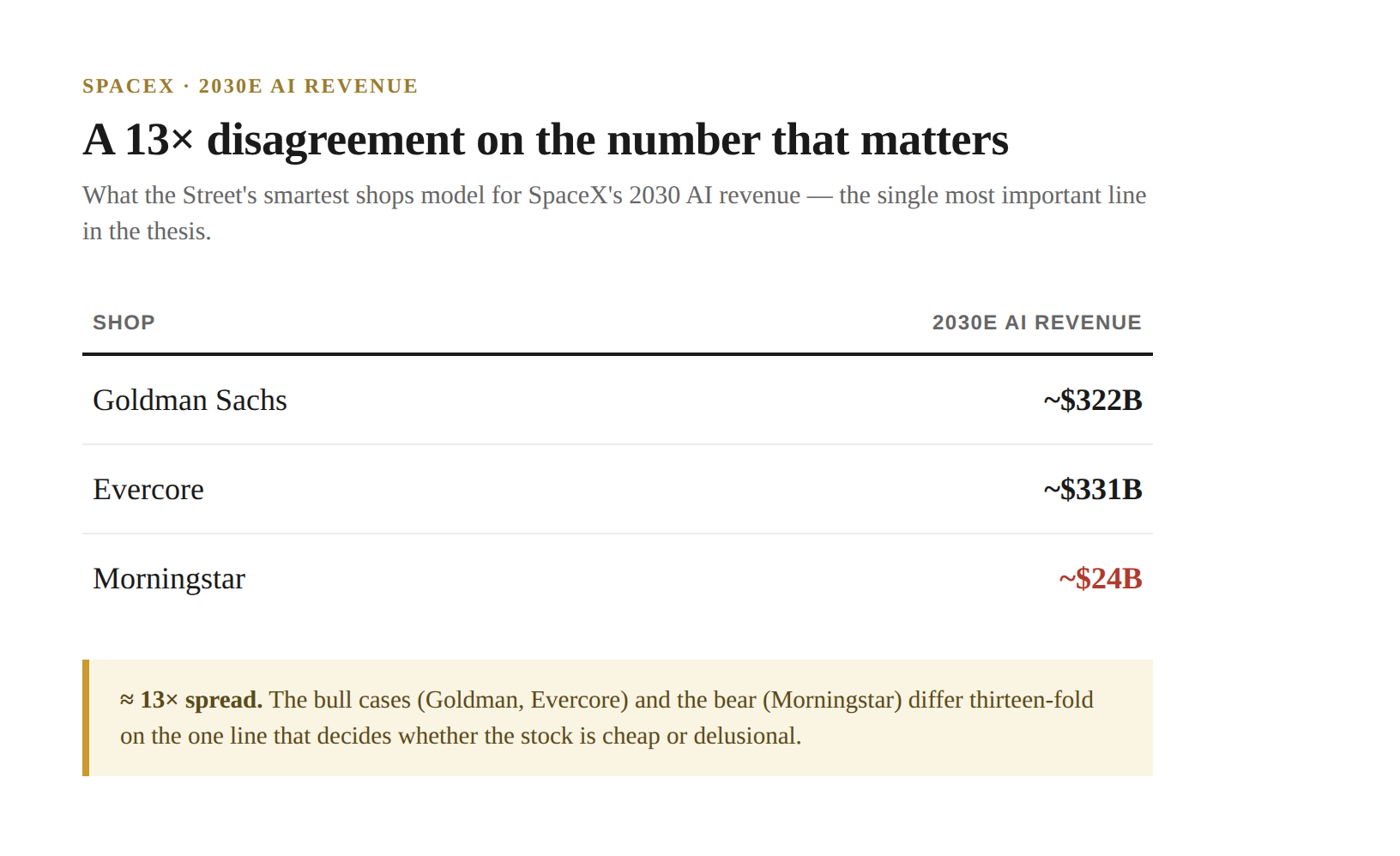
That is not a rounding difference. It’s a thirteen-fold spread on the number that decides whether the stock is cheap or delusional, and the entire gap reduces to one question: do the Anthropic and Google leases renew and scale (Goldman, Evercore), or roll off without renewal (Morningstar)? When the best analysts on the Street disagree by 13x on your most important line, what you own isn’t a valuation. It’s a bet on which story wins — and the counterparties, not you, hold the pen.
The Supply Schedule: The Only Part With a Date On It
Everything else in this story is a probability — will Starship fly, will AI margins hold, will the leases renew. The share-supply schedule is different. It’s the one fact in the thesis that comes with a calendar, and the market treats a contractual certainty like a tail risk.
Today the tradable float is under 5%. That thin float is why the stock can melt up and give it all back inside a month; thin supply cuts both ways. But the direction turns one-way as the lock-ups release, and it releases in steps — the early buckets lift float into the mid-teens, the six-month unlock pushes it toward ~40%, and it drifts higher from there. The cliff is the last one: Musk’s roughly 6.4 billion shares unlock about a year out, taking tradable float toward ~98%.
Rising supply meeting a stretched valuation isn’t a surprise you hedge against; it’s a schedule you can read off a filing. And here’s the counterintuitive twist worth sitting with: more float can increase short pressure, not relieve it. Borrow cost runs high on a sub-5% float; as shares free up, borrow gets cheaper, and cheaper borrow lets more shorts on. The supply cliff doesn’t just add sellers — it arms them.
Bull, Bear, and What Each Host Actually Thinks
Strip away the noise and the two cases are clean.
The bull: SpaceX owns an unmatched launch monopoly, a genuinely profitable telecom in Starlink, and free optionality on Starship, AI, and Mars — bought at the price of a premium the market keeps paying. When one company can be the toll operator on an entire frontier, you overpay and you don’t apologize.
The bear: the profitable parts don’t support the price, the AI revenue is cancelable, the frontier is hard to defend, and “optionality” is doing almost all the valuation work. Take out the Elon premium and the math turns ugly fast.
Between the two hosts, the split is a real disagreement, not a hedge.
Joseph Kim is the more bearish, and specifically on AI economics — distillation compressing the frontier, the coming migration to local models, an unprofitable coding war, and Grok’s data-provenance problems all leave him wanting a better price. His discipline is what’s proven: the launch monopoly and Starlink are underwritten; Starship and AI are faith.
Matthew Kanterman’s caution runs through structure and duration — price it like a call option, respect the fat right tail and the real chance the premium expires worthless, and mind the supply cliff. Neither hands you a target. Both hand you a framework, and they land in different places inside it.
Each side has a clean falsifier, and naming it is what separates analysis from narration.
The bull is wrong if a tenant walks at the first lock-up test, or the coding war never turns profitable.
The bear is wrong if those leases go longer-dated and non-cancelable — the moment they become committed take-or-pay, the $26B stops being a mirage and starts being bookable ARR, and the stock looks cheap.
Governance: Read the Related-Party Lines
Then there’s the structure — and the honest version isn’t merger gossip, it’s the related-party mechanics already in the filings. The xAI merger valued xAI at ~$250 billion in an all-stock deal — SpaceX buying the CEO’s other private company with SpaceX stock. The Cursor (Anysphere) acquisition ran ~$60 billion, all-stock, roughly 3.3% dilution. And the data-center real estate runs through
Valor sale-leasebacks — a related party whose founder, Antonio Gracias, sits on the board. Speculation that SpaceX and Tesla eventually merge isn’t idle either; it’s the logical endpoint of an empire that treats corporate boundaries as suggestions. For an investor, that’s the whole thing in miniature: you are not buying a business with clean edges. You are buying exposure to Elon’s capital allocation — much of it transacted in his own stock, with his own related parties.
How to Actually Bet On It
So how do you play it? It depends on who you are:
Traders get a liquid, high-beta, headline-driven vehicle — respect the float, respect the squeezes, respect the supply calendar, and size accordingly.
Long-term investors have to answer one question honestly: do you believe Starship works and the AI business becomes defensible? If yes, the price may look cheap in a decade. If no, you’re paying a trillion-dollar premium for a very good telecom.
Builders and operators should watch the cost curve, not the ticker — cheaper launch and cheaper compute reshape what’s buildable regardless of what the stock does.
The Trillion-Dollar Question
Underneath all of it is a single idea: economic rent. The most profitable position in any economy is the toll operator — the one who takes a small cut from everyone doing everything. Own the road to orbit, own a meaningful layer of AI compute, and you collect that toll across two frontiers at once. That is the bull case in one sentence, and it’s why a trillion-dollar-plus price tag can be argued with a straight face. In a world of persistent inflation and genuine platform shifts, ten-trillion-dollar companies are no longer unthinkable.
But optionality is not a plan, and a premium is not a proof. Some of the wildest ideas — orbital data centers, Mars economies — sit outside any honest investable horizon; the physics may exist, but the economics don’t, and “it’ll happen faster than you think” has been wrong about every frontier from fusion to quantum for decades.
So the question isn’t “is SpaceX a good company?” It obviously is. The question is narrower and harder: are you buying a rocket company that might become an AI company — or an AI call option that happens to own the best rockets on Earth? Answer that, and you’ve answered whether the biggest IPO in history is the buy of the decade or its most expensive lesson.
Key Takeaways
Frame it as a call option, not a company. A ~$250B base business plus a ~$1.5T premium for Elon-scale optionality — price both halves.
The profitable parts don’t reach the price. Launch (~$4B) and Starlink-led connectivity (~$11.4B) are excellent, but launch + telecom alone are worth ~$250B, not $1.5 trillion.
The valuation lives in AI — and don’t confuse the two AI numbers. ~$3.2B is recognized revenue; ~$26B is a forward run-rate on cancelable leases. The xAI/Colossus pivot closes the gap, and it’s the least proven, hardest-to-defend piece.
The $26B is commodity, concentrated, and cancelable — and owed by your competitors. The Anthropic and Google leases are huge, back-solve to ~$8–12/GPU-hour, come from two customers, cancel on ~90 days’ notice, and both tenants build rival frontier models. Don’t capitalize it like recurring revenue.
Thirteen-x disagreement is the tell. 2030 AI revenue: Goldman ~$322B, Evercore ~$331B, Morningstar ~$24B. That spread means you own a narrative, not a valuation.
The supply schedule is the only dated fact. Float goes from under 5% toward ~98% as Musk’s ~6.4B shares unlock — and more float can mean more short pressure, not less.
Starship is the swing factor. Full reusability, orbital refueling, and a reusable heat shield are unsolved. The bull owns every unlock; the bear only needs a few to stall.
China, not Blue Origin, is the competitor that matters — because it doesn’t need to win, only to stop buying and take its own share.
It’s a framework, not a price target. Decide what you believe about Starship and defensible AI, then size the position to match your conviction — and the float.