
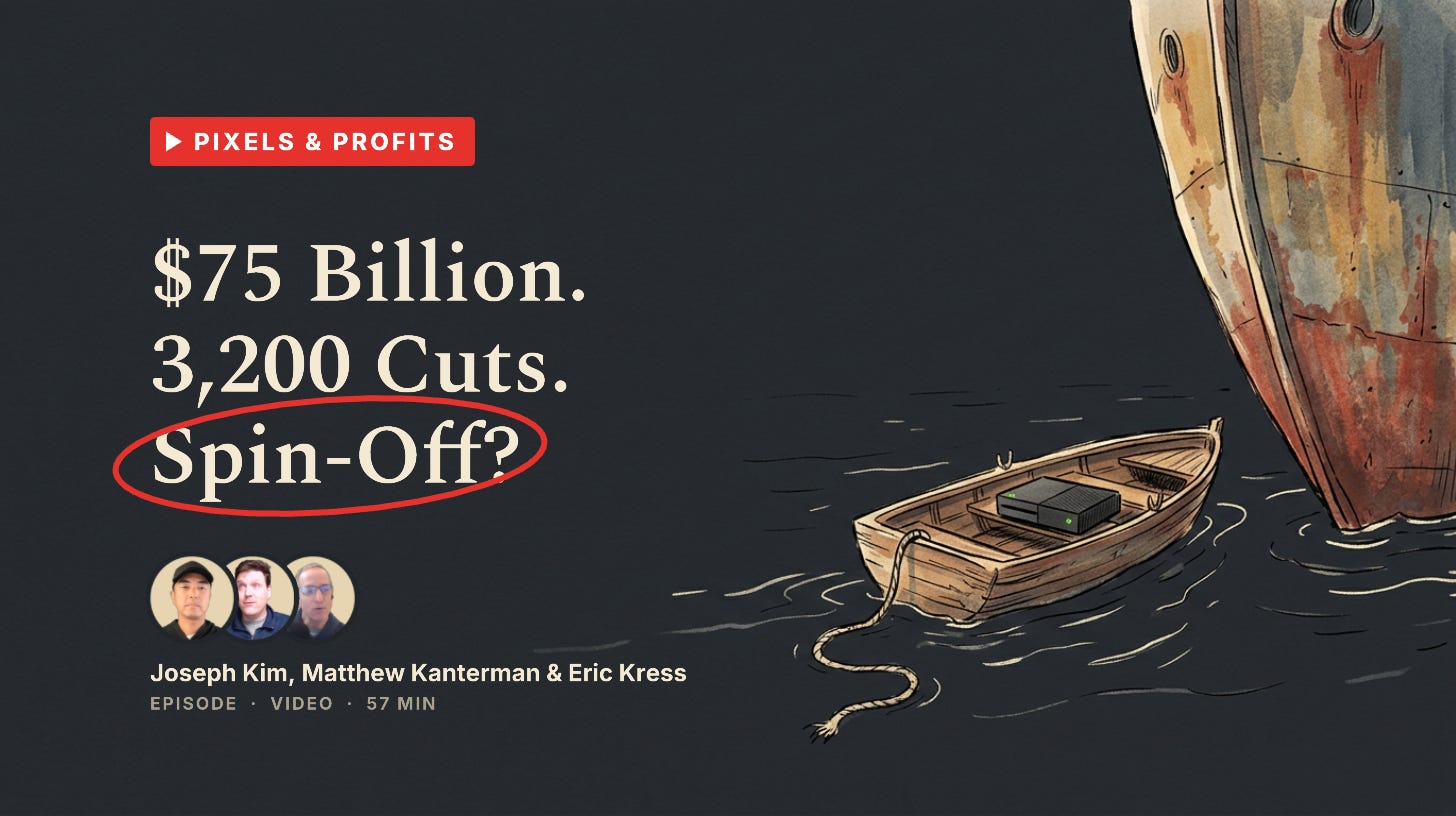
Microsoft paid $75 billion for Activision Blizzard. The deal closed in October 2023, and less than three years later, its new gaming CEO, Asha Sharma, told employees that Xbox had "spread ourselves too thin." She then announced about 3,200 job cuts, roughly a fifth of the gaming workforce, and four studios left the company.
So what happened? And the bigger question: what is Xbox supposed to be now?
On the latest Pixels & Profits, Matthew Kanterman (Director of Research at Blue River Financial) and I were joined by Eric Kress of Deconstructor of Fun. We went through the current business, the reset that started this February, and where Xbox goes from here. By the end, both of them had convinced me of something I didn't believe going in.
How Xbox lost its lead
Matthew started with a short history lesson. The original Xbox launched a year after the PS2 and sold roughly 25 million units against the PS2's roughly 160 million. That was a respectable start. The 360 is where Xbox stole the show: first to market with real online multiplayer, Halo as the spearhead, and roughly matching the PS3. Since Xbox has almost no presence in Japan, where Sony gets about 10 to 15% of its unit sales, Xbox actually beat Sony in the West.
Then the Xbox One. Kinect, which nobody wanted and which added close to $100 to the price. Eric's diagnosis was blunt: a wave of tech executives tried to expand Xbox beyond what it was meant to be, and the company evaporated its lead against Sony in a single generation. Matthew's numbers tell the rest: the Xbox One got doubled up by the PS4, and the Series consoles are roughly 3 to 1 behind PlayStation today.
My own view is a little different. For me, Game Pass was the downfall. You used to buy Nintendo for Mario and Pokémon, Xbox for shooters like Halo, PlayStation for its RPG games. Game Pass moved Xbox away from exclusives, and once the games show up everywhere, there's no real reason to buy the box. Eric agreed and went further: subscriptions and streaming were a Microsoft-wide strategy imposed on a business where, in his view, both are the wrong ideas. Matthew pointed out that Satya Nadella said on earnings calls in the early 2020s that Microsoft wanted to build consumer subscriptions, including Game Pass, the way it had built enterprise subscriptions. Whether that came from the top or was sold upward by Xbox leadership, once it was decided, the whole company was behind it.
The numbers: four years of decline
Microsoft is on a June fiscal year. Per Matthew, hardware revenue has declined four fiscal years in a row: down 11%, 13%, 25% and 29% from July 2022 through June 2026. Strip out Activision, the only real source of inorganic growth, and the content business is flat at best by his napkin math, down 6% at constant currency in the most recent fiscal year, even with last year's Game Pass price hikes. The most recent quarter was down 10%.
The 500 million MAU figure sounds like a platform to build on until you notice that a big chunk of it is King, Call of Duty Mobile and Minecraft, things most people don't think of as Xbox.
Eric added that the install-base gap understates the problem. Current unit sales are closer to 8 to 1 for Sony versus Xbox, by his estimate, which is a leading indicator. And Xbox's share of third-party software, where the margin in this business really is, has fallen from around 35 to 40% to around 15%.
Microsoft doesn't disclose Xbox profitability. Sony's games business runs at roughly 20% EBITDA margins, and larger publishers without hardware are more like 30 to 40%. Matthew's guess, with no inside information, is that Xbox is somewhere around 10%. Sharma herself said Xbox's margins are three to ten times lower than comparable platform and publishing businesses. Whatever the exact number, the top line has been falling for years and the margins are well below peers. Job cuts alone don't fix that.
The reset
Here's the sequence as reported:
February 20: Asha Sharma became CEO of gaming, reporting to Satya Nadella. Matt Booty became chief content officer. Phil Spencer is retiring and Sarah Bond left.
April: the unit was formally renamed Xbox.
July 6: Sharma announced the reset on Xbox Wire: about 3,200 job cuts through fiscal 2027, roughly 20% of an estimated 16,000-person gaming staff per press reports. About 1,600 people were laid off that day, and about 350 more left with four studios being spun out: Ninja Theory, Undead Labs, Compulsion and Double Fine.
July 30: The Verge reported a further memo with two goals: return to player and revenue growth by the end of fiscal 2027, and bring profits back toward industry averages. It also said three unnamed franchises are already over $1 billion each (my guess: Call of Duty, Minecraft and Candy Crush) and that the console generates the majority of Xbox revenue. Matthew's read is that this means the whole console ecosystem, where the profit comes from a 30% cut of third-party sales, not the hardware itself.
September 22: Matt Booty's update on the studio reorganization. Rare, the Age of Empires team and a new Halo team move under Activision. Obsidian moves to Bethesda. King takes over Microsoft Casual Games. Playground and Turn 10 merge into one Forza and Fable studio. Another 268 roles were cut. Compulsion and Double Fine have left with their IP, Undead Labs has left on similar terms, and Ninja Theory, after two deals fell through, now faces a proposed closure.
Matthew put on his old sell-side analyst hat about Sharma's bleak framing of the business: new leadership gets two or three quarters to sandbag expectations, then beats them. And no sell-side analyst covering Microsoft cares much, because Xbox is a rounding error for Microsoft as a whole.
The easy part is done
Eric was critical when Sharma was hired, but he says every move she has made so far makes sense: cut the smaller studios and games that don't add much to the portfolio, and keep Mojang and King, the most profitable assets and the ones that could feed something larger. (The Kojima deal is the exception he can't explain.)
But he was clear: this is the easy part. Any team at Goldman or Morgan Stanley could have put together cuts and a reorg. The hard part is managing studios going forward, and the fundamental problem is still there: the platform is collapsing, and none of the reorganization matters unless that gets fixed.
Matthew's twist: that assumes Microsoft sticks around for the execution phase. A Blizzard pipeline announced years ahead, a new XP division with futuristic tech and TV licensing deals: in his view, these are things you put in a prospectus to sell the next investors on growth. They're the selling points for spinning Xbox out as a standalone company.
On Game Pass, the most important strategic question, Microsoft has said almost nothing. The last official count I know of was 34 million subscribers in February 2024, including the Core tier, and the Wall Street Journal reported 30 million in 2026 against a goal of 77 million. My guess is a slow wind-down, or a shrink into a back-catalog service. Matthew thinks they keep it alive until after a transaction, so the shutdown can be shown to new investors as future cost savings. Eric thinks a premium tier for the most loyal Xbox fans makes sense as long as the platform exists, and goes away when it doesn't.
Hardware: OEM or exit?
This is where the conversation changed my mind. Eric says we've seen no hardware strategy at all. His tell for the future: if Xbox licenses its platform to third-party PC makers, that's the end of the line. Outside OEMs get none of the volume advantages Sony gets at 20 million units a year, face the same memory costs and the same bill of materials, and would likely price those boxes at $800 to $900. It doesn't save the platform.
Matthew thinks that's exactly what happens, through a handful of partners, and notes there's no risk to Microsoft in trying. One possible upside he raised: a partner could build a cheap, streaming-only box for emerging markets without consoles, though that depends on there being something to play that beats Fortnite on your phone.
Asked what Xbox should do instead, Eric's answer was simple: get rid of the Xbox platform and become a publisher. Activision 2.0. Become EA or Take-Two. Matthew has already assumed the hardware business is dead. I came in thinking they'd try to save hardware. After this discussion, I don't think it makes sense.
Spin out, then carve up?
Both of them think Xbox is being set up to leave Microsoft. Where they disagree is what happens after.
Matthew's view: Xbox is too big for any single buyer and too big for a standalone leveraged buyout, given four years of declining financials. So Microsoft spins it out, and once it's independent, the pieces become separately buyable: Activision, Blizzard, King. And if Blizzard is actually for sale, why would anyone fund "the next Blizzard" instead of buying Blizzard?
Eric's view: keep it whole. Based on his conversations with bankers, the likely structure is that Microsoft keeps around 40% and spins out roughly 60% to willing investors such as sovereign funds, with all equity and no heavy leverage. As a profitable publisher without the hardware business, it could be a healthy public company, the way Take-Two is.
The underlying disagreement is about what to optimize for. Matthew thinks the industry has gone too far toward live services and recurring revenue, and that the real value came from making great games. Eric thinks that ship has sailed.
What they agree on: Sharma is preparing for a spin-off while keeping both options open, and the only real point of no return is giving up hardware. Matthew's timeline is specific. He expects an announcement around fiscal 2027 earnings, late July or early August next year: either a consortium buying 60-something percent or a tax-free spin to Microsoft shareholders, with Xbox independent of Microsoft by June 2028. Eric thinks that's why the hardware strategy is being held back: dropping it is the last big cost saving that makes the numbers look whole.
Is console shrinking?
I pushed a thesis of my own: since COVID, the center of gaming seems to have moved to PC and to friend groups on Discord. I haven't touched my consoles in a long time, and the kids I watch play Roblox, Minecraft and Valorant on PC.
Both of them disagreed. Eric's point is that the console install base has been roughly flat for three generations, is only about 10% below last generation right now even with Xbox's problems, and that console players are the valuable 18-to-44 core audience that spends the most money. Kids play whatever they can on phones, then grow into consoles and PC. Matthew added that PlayStation's monthly users are still growing a couple of million a year and that a console is still cheaper than a comparable gaming PC. I still predict a decline in usage. We'll see.
AI, Minecraft and King
The last open question is whether Microsoft keeps Minecraft and King for itself, for AI data or anything else, or puts them in the spin-off. Matthew and Eric agree: to make a spin-off attractive, the growth assets have to go with it. King barely grows but runs at around 50% margins, and Minecraft has a lot of untapped value. A data-licensing deal back to Microsoft would be the logical way to keep the AI benefit.
Where we land
The platform is the problem. Xbox lost its reason to exist when exclusives went away, and four years of hardware decline show it.
The reset is competent but mechanical. The cuts and the reorg are the easy part. Nothing in them fixes the platform.
Watch for OEM hardware. If Xbox licenses its console to third parties, the platform is effectively over.
A spin-off looks likely. Matthew expects the announcement around fiscal 2027 earnings and independence by June 2028. They disagree on whether it stays whole.
As Matthew put it, quoting Game of Thrones: what is dead may never die. But the Xbox as we know it is a dying breed.
Are we right? Spin-off, OEM, or a comeback: tell us in the comments.
Watch the full episode on YouTube, and subscribe to the channel so you catch the next one.
This article is for informational and educational purposes only and is not investment advice. Figures are as discussed at the time of recording, many are the speakers' own estimates, and they should be verified against current data before acting.